Designing Learning Around Place, Culture and Purpose: Academyati’s DEC Journey
Academyati is Qatar Foundation’s first progressive school, offering a values-led, personalised and experiential approach to learning that empowers learners to explore, create and connect their learning to the real world.
When Academyati approached Class Of Your Own to explore how Design Engineer Construct! could support its vision, we started with our established DEC approach and adapted it thoughtfully for Academyati’s learners, culture and context.
Working collaboratively with a fantastic team of highly experienced teachers, our existing ‘Design a Natural History Centre’ DEC Award was contextualised for Qatar’s curriculum, environment, identity and values, supported by DEC teacher training inn sustainable design and digital tools.
What emerged was an ambitious whole school DEC experience, connecting learners from age three upwards through one shared challenge while retaining the core DEC process and progressively increasing the complexity, independence and technical application of the learning.
One Vision. Every Learner.
From the design of Insect Houses to an inclusive Natural History Centre: Academyati’s DEC programme is an exciting, vertically connected design and engineering journey rooted in Qatar, Islamic values and sustainability.
One challenge, four connected stages
At the heart of the project was one shared driving question:
How can we design a Natural History Centre that inspires our community to understand and protect the natural world?
The challenge was scaffolded across four connected stages, increasing in complexity, independence and technical application:
Stage 1 | Ages 3–5 — Insect Houses
Learners explored insects, habitats and the needs of living things, designing Insect Houses for the Biodiversity Gardens.
Stage 2 | Ages 6–9 — Biodiversity Gardens
Learners extended their thinking from habitats to ecosystems, designing sustainable gardens to support local wildlife and incorporate the Stage 1 Insect Houses. Younger learners knew their work would become part of an older learner’s final design, increasing ownership and purpose.

Stage 3 | Ages 10–13 — Exploration / Innovation Labs
Learners applied increasingly sophisticated research, design and problem-solving skills to create specialist Exploration and Innovation Labs for the Natural History Centre.

Stage 4 | Age 14+ — Natural History Centre
Learners brought the whole-school project together, designing the complete centre and considering site, concept, structure, sustainability and spatial organisation. Their designs explicitly incorporated the younger learners’ Labs, Biodiversity Gardens and Insect Houses. Older learners worked with authentic design software while balancing environmental, cultural and spatial considerations.
Habitat → Ecosystem → Specialist Learning Environment → Complete Built Environment
Each stage built upon the previous one, creating a connected whole-school design journey. The work of the youngest learners became part of the design brief of the old

Connecting Rihla with DEC
DEC was integrated directly into Academyati’s Rihla learning cycle, creating a natural alignment between the two approaches:
Define & Inquire → Exploration
Develop → Goal Setting
Create & Deliver → Creation
Evaluate → Learning Festival
This allowed learners to experience the DEC design process through a familiar approach to learning; exploring ideas, setting goals, creating and refining solutions, and sharing their learning through the Learning Festival.
The Rihla value of Excellence sat at the heart of the project, encouraging learners to persevere, respond to feedback and continually develop the quality of their work.
Personalised learning through coaching
While every learner contributed to one shared challenge, no two learning journeys looked exactly the same.
Teachers coached learners to identify personal goals, reflect on their progress and make decisions based on their strengths, interests and readiness. As the complexity of the project increased, so too did learner independence, ownership and confidence.
The project also reflected Academyati’s Portrait of a Learner, providing authentic opportunities for learners to become:
Rather than focusing solely on producing a final product, learners developed the dispositions, habits and competencies that underpin lifelong learning.

Rooted in Qatar, Culture and Islam
The DEC challenge was shaped around Qatar’s environment, culture and Islamic context, connecting the project to the world learners know and experience.
Learners explored Qatar’s climate, habitats, plants and biodiversity, alongside sustainability. Bees and pollination connected learning to Education City’s apiary and honey production in Qatar, while designs incorporated local and regional planting and majlis-inspired spaces reflecting Qatari ways of gathering.
Islamic perspectives were woven into the learning through exploration of plants referenced in the Qur’an, including fig and olive (Surah At-Tin 95:1), rayḥān (Surah Ar-Rahman 55:12), date palm (Surah Maryam 19:25), olive (Surah An-Nur 24:35), and pomegranate and date palms (Surah Ar-Rahman 55:68).
Together, these connections encouraged learners to consider:
What should a Natural History Centre designed in Qatar, for our community, look like and represent?
Faith → Nature → Stewardship → Sustainability → Design → Everyday Life
Interdisciplinary learning: from farm to table
Learning extended beyond the original DEC brief as ideas developed across the curriculum. A strong example emerged from the Stage 2 Biodiversity Gardens, where learners explored plants suited to their garden designs, including figs, basil, dates, olives and pomegranates.
These plants became the starting point for a Farm to Table experience. Learners explored their Qur’anic connections, considered how they could be grown and used, and then worked with the ingredients to create food. Their learning was captured in a student Recipe Book, bringing together biodiversity, sustainability, Islamic Studies and practical food learning.
Professional expertise and technical learning
To support the whole-school approach, 23 Academyati staff completed face-to-face DEC training in Doha, building a shared understanding of the DEC process across the different stages.
Older learners also worked directly with a DEC trainer through an online professional development session, learning to use Homestyler to develop their Natural History Centre designs. This introduced more advanced spatial and architectural thinking as learners moved from initial concepts to digital design.

Transforming the school: learning festival, agency and impact
The project culminated in Academyati’s whole-school Learning Festival, bringing together DEC’s Evaluate stage and the final phase of the Rihla cycle.
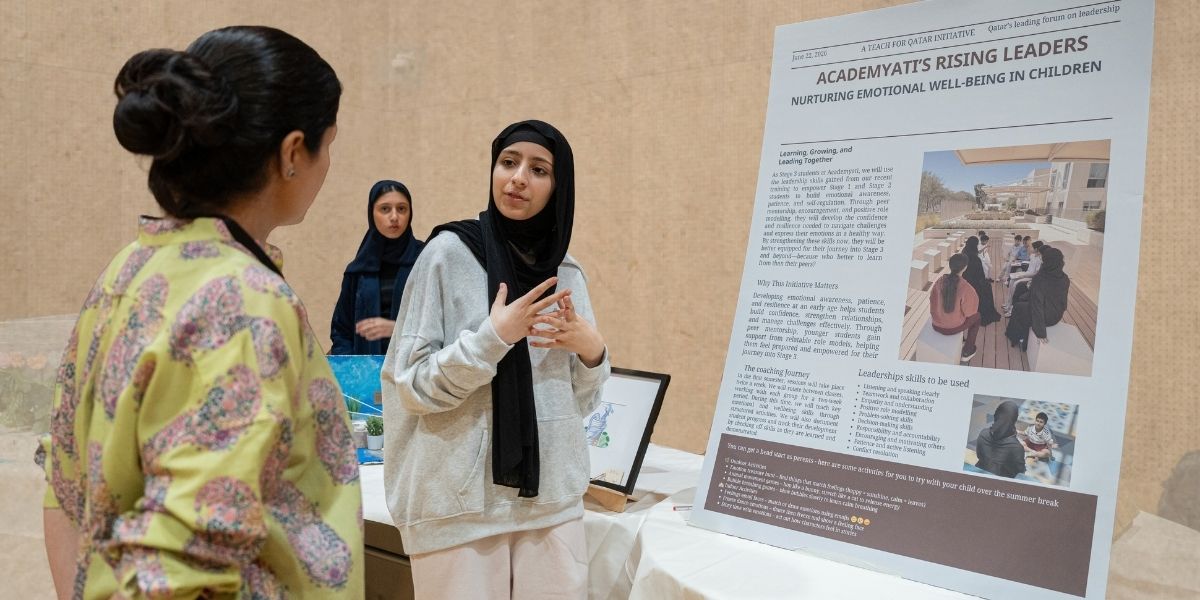
For the Festival, the school was transformed to showcase the DEC journey, from Stage 1 Insect Houses and Stage 2 Biodiversity Gardens to Stage 3 Exploration / Innovation Labs and the final Stage 4 Natural History Centre designs. Learners presented their projects and portfolios to families and the wider school community, explaining their design choices and the process behind their work.
All students successfully completed their DEC projects and met the requirements of the DEC rubric, demonstrating how the framework could be adapted across the school while maintaining clear expectations for learning and outcomes.
Impact
Impact on Learners
Every learner successfully completed their DEC project and met the requirements of the DEC rubric.
More importantly, learners experienced the satisfaction of contributing to something beyond their own classroom while developing confidence, creativity, collaboration and resilience.
“One of the most notable strengths was the children’s confidence and pride in showcasing their learning journey.”
Staff Member
Parents recognised the depth of ownership learners demonstrated throughout the project.
“I appreciated the fact that the children created so much by themselves—from the garden designs and ideas to the posters. Every week they learned something new and applied it in meaningful ways.”
Parent
“My child was able to make clear connections between their learning and the Rihla values through the activities and projects presented.”
Parent
Impact on Teachers
Teachers developed greater confidence in facilitating authentic, interdisciplinary and project-based learning while working collaboratively across different stages of the school.
The shared design challenge strengthened professional dialogue and created a common language around inquiry, design and authentic assessment.
Impact on culture
Perhaps most significantly, the project strengthened Academyati’s culture of connected learning.
The youngest learners understood that their ideas mattered because older learners would build upon them.
The oldest learners recognised their responsibility to honour and incorporate the work of those who came before them.
Learning became a genuinely collective endeavour.
The Academyati difference
Academyati did not simply implement DEC.
We reimagined it through the lens of our own educational philosophy.
What made this project distinctive was not only the quality of the final designs, but the way it connected every aspect of learning across the school.
Across the DEC journey, whole-school learning, progressive challenge, Qatar’s culture and environment, Islamic perspectives, Rihla values and interdisciplinary learning came together within one connected project.
Our DEC journey brought together:
From an Insect House designed by a three-year-old to a complete Natural History Centre developed by the oldest learners, each stage had a clear place within the final vision. As learners progressed, so did the scale of their thinking, independence and technical application, while their work remained connected across the school.
Ages 3–14+
180 Learners
23 DEC-trained
staff
4 connected
stages
1 whole school
design challenge
1 learning
festival
All students successfully
meeting DEC rubric
For Academyati, the experience extended beyond design and engineering. Learners applied knowledge, pursued their curiosity, worked through challenges, collaborated with others and considered their responsibility towards their community and environment.
The project reflected Academyati’s wider approach to learning: connecting knowledge with experience, values with action, and individual growth with contribution to the world around us.
About Academyati and the DEC Vision
Academyati Vision
Our vision is for children to grow as ethical creators who are aware, confident, empowered and can bring positive change to their world.
Academyati Mission
Cultivating children’s independence, empathy, curiosity and creativity through their distinctive and unique experiential journeys.
At Academyati, one design challenge connected every learner from age three to Grade 9. Over several months, learners designed a Natural History Centre for Qatar, with each stage contributing an increasingly sophisticated piece of one shared vision. From insect houses built by our youngest learners to a fully realised architectural proposal created by our oldest, every learner became both a designer and a contributor to something larger than themselves.
Book a DEC DISCOVERY CALL
Chat about learning, teaching and supporting DEC with one of our team
Are you from industry?
Visit the COYO website and learn how you can recruit exceptional DEC talent,
improve your organisation’s diversity and surpass your ESG commitments!